
Why Men and Women Are Moving Apart — and How Families Can Bridge the Gap

“Why Young Women Moved Left While Young Men Stayed Sane“.
It’s an attention-grabbing headline — and the article delivered.
Posted by an enigmatic X user calling himself Vittorio, this piece of writing has racked up over 31 million views in just a fortnight, and sparked a global conversation.
The impetus for the article came from billionaire investor Bill Ackman, who quote-tweeted a graph showing the widening political gap between young men and women in the United States.
How wide? The gap has almost doubled over two decades, growing from 12 points in the year 2000 to 23 points in 2023.
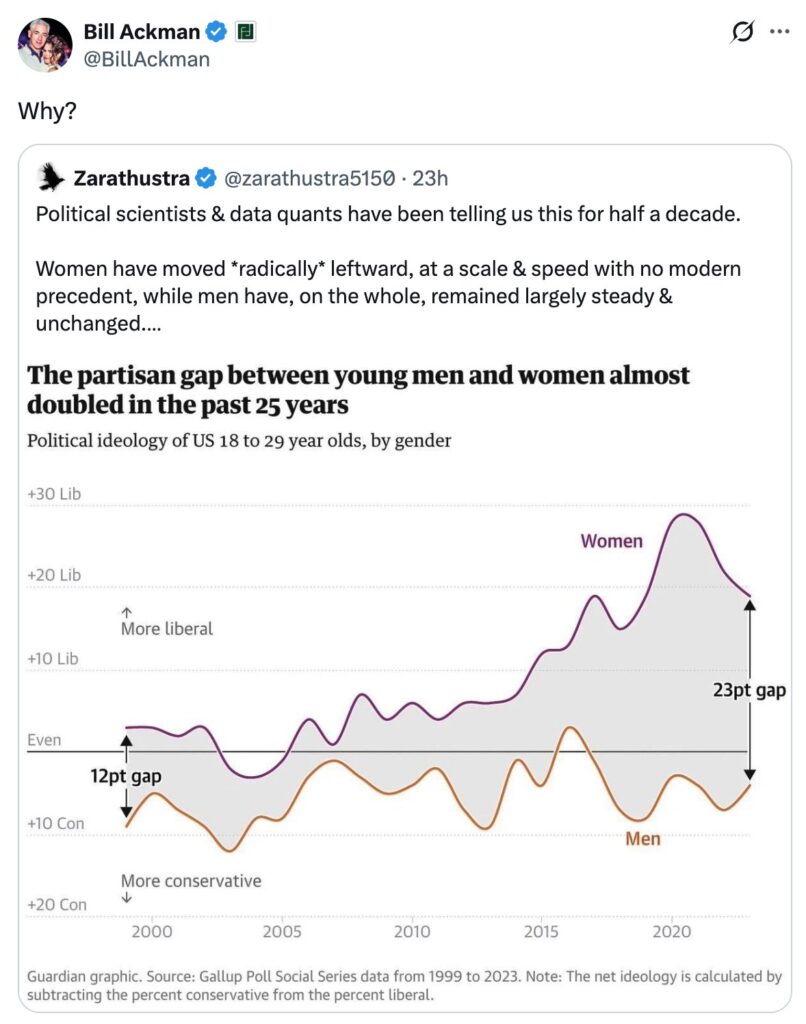
Vittorio went on to reveal a striking trend: over the past two decades,“Women moved radically left. Men stayed roughly where they were.”
As Vittorio noted, this isn’t just an American phenomenon. The Financial Times has documented similar trends across dozens of countries, from the UK and Germany to Australia, Canada, South Korea, Tunisia and Brazil.
South Korea is a particularly striking case: young men there are overwhelmingly conservative, while young women are overwhelmingly progressive, despite very different cultural and political pressures.
The well-known podcaster Allie Beth Stuckey recently addressed Vittorio’s article, noting that it isn’t just a story about politics or the so-called “culture wars”. It’s about the social, psychological and behavioural forces that help explain how young men and women respond to the world around them.
And if you’re interested in hearing reflections on the article from a male perspective, here’s one by my friend Jamie Bambrick:
For fathers raising sons and daughters, these trends are worth understanding — because they show how committed fathers and family life can help children grow into balanced, resilient adults.
To understand why men and women have drifted apart — and how fathers and families can help bridge the gap — it’s worth exploring the forces Vittorio identifies as driving these changes.
Biology
Vittorio begins by pointing out the inherent biological differences in how men and women respond to social pressures. Women tend to be more sensitive to social feedback and attuned to consensus, while men are generally more tolerant of disagreement and conflict. As he puts it:
Women evolved in environments where social exclusion carried enormous survival costs. You can’t hunt pregnant. You can’t fight nursing. Survival required the tribe’s acceptance: their protection, their food sharing, their tolerance of your temporary vulnerability…
Men faced different pressures. Hunting parties gone for days. Exploration. Combat. You had to tolerate being alone, disliked, outside the group for extended periods. Men who could handle temporary exclusion without falling apart had more options. More risk-taking, more independence, more ability to leave bad situations.
As a Christian, I’d argue that divine design offers a far more compelling explanation: God created and hardwired men and women as complementary partners to steward creation, solve problems, raise the next generation and civilise the world.
Regardless of their origin, these biological differences are clear and have real-world consequences. Personality research across 55 cultures, as cited by Vittorio, reveals a consistent pattern: women generally show higher agreeableness and sensitivity to social cues, while men display greater tolerance for disagreement and resilience under conflict.
Technology
Vittorio points to social media as a powerful accelerant of these trends. Platforms like Facebook, Instagram and, more recently, TikTok form a kind of machine — a “consensus engine” that broadcasts social norms and enforces them through visible peer approval and disapproval. As he observes:
The tribe used to be 150 people. Now it’s everyone you’ve ever met plus a world of strangers watching…
This machine wasn’t designed to capture women specifically. It was designed to capture attention. But it captures people more susceptible to consensus pressure more effectively. Women are more susceptible on average. So it captured them more.
The introduction of smartphones in 2007 put this engine in everyone’s pocket, creating constant feedback loops. Women, on average, are more attuned to social cues and rejection, so these algorithms encouraged emotional engagement and reinforced ideological conformity.
Men, by contrast, were drawn to other dopamine loops — video games, forums, pornography and outrage content — which kept them distracted, entertained, and less susceptible to the same pressures.
Institutions
Institutional environments reinforced these patterns. Universities, particularly in the humanities, social sciences and education, became majority female. Young women spent years immersed in environments that encouraged them to align around a single dominant worldview:
Four years surrounded by peers who all believe the same thing. Professors who all believe the same thing. Reading lists pointing one direction. Disagreement is not even rare, it’s socially punished. You learn to pattern-match the acceptable opinions and perform them.
Then they graduate into female-dominated fields: HR, media, education, healthcare, non-profits, where the monoculture continues. From 18 to 35, many women never encounter sustained disagreement from people they respect. The feedback loop never breaks.
As an aside, cultural critic Helen Andrews has made a similar point in her own viral essay, ‘The Great Feminisation’. There, she notes that as institutions became female-dominated, norms associated with women — prioritising consensus, empathy and safety — have increasingly shaped those environments, reinforcing the ideological conformity Vittorio describes.
Men, by contrast, were more often in trades, engineering, finance or the military — environments where disagreement was tolerated, outcomes mattered more than consensus, and critical thinking was rewarded, producing very different experiences and worldviews.
Marriage
The collapse of early marriage and delayed family formation over the past few decades has acted as a destabilising force. Vittorio notes that single women tend to vote more left, while married women lean more conservative, and for a very simple reason:
Single women interact with government more as provider of services. Married women interact with government more as taker of taxes. The incentives point different directions.

Without the stabilising anchor of marriage, young, career-focused women were more exposed to ideological pressures. Vittorio notes that marriage changes not only economic incentives but social context: married women are embedded in a family unit, exposed to the needs of spouses, children, and extended kin. This daily engagement with real-world responsibilities cultivates practical thinking, encourages compromise, and creates a pragmatic buffer against the echo chambers of social media or peer-only environments.
Ideology
Finally, Vittorio highlights how ideology can become self-reinforcing. Many women have built careers and identities around independence-first principles, making it psychologically costly to admit these ideas have flaws. As he writes:
Now they’re 35, unmarried, measuring declining fertility against career achievements. And here’s the trap: the sunk cost of admitting the ideology failed is enormous. You’d have to admit you wasted your fertile years on a lie. That the women who ignored the ideology and married young were right. That your mother was right…
Easier to double down. Easier to believe the problem is that society hasn’t changed enough yet.
Men, by contrast, were initially less influenced by consensus pressures, but are now reacting to the widening cultural gap.
Passivity and withdrawal are now turning into active opposition, as men push back against a society that increasingly penalises traditional masculinity.
Conclusion: How Families Can Bridge the Gap
Vittorio’s closing analysis paints a stark picture: the “machines” of social media, institutional pressures and ideological capture are self-reinforcing.
Women, more susceptible to consensus pressure, were captured first. Men are now being pulled in different directions, often through withdrawal or reactive opposition.
The result, he warns, is two diverging lines — two different failure modes — playing out in real time. “Both machines are still running,” he laments — presumably towards civilisational chaos and despair.
But there’s a counterbalance he doesn’t dwell on: the family.
Loving, present families provide the structures that can interrupt these feedback loops. Fathers and mothers, by marrying well, staying committed and investing intentionally in their children, give sons and daughters practical experience, accountability, and real-world perspective.
Sons learn resilience, how to handle disagreement, and purpose-driven engagement with the world. Daughters learn discernment, the value of long-term relationships, and confidence to navigate social pressures without being swept along.
In other words, while society’s machines push in different directions, families can pull children back toward stability, balance, and grounded worldviews.
Unlike social media or institutions, families offer lasting, human-scale influence — a hope-filled solution to the trends Vittorio identifies.
___
Image courtesy of Freepik.

Related News

How is it that despite looking like we have the things we need, we are unhappy, frustrated, even angry? As the world looks to behavioural change programs to deal with tragedies like domestic violence, Guy argues that perhaps, for men who are at risk of ‘snapping’, an answer is more deeply hidden but oh so easy to get. Meet Jim I want to introduce you to Jim. Jim is the unhappiest ...
Guy Mullon

What Angie and I are learning during this season is just how differently the two of us are wired. Motherly instinct is an incredibly powerful force, and this holds just as true for an adoptive mother as for a biological one.
Kurt Mahlburg
News
Dads4Kids News is for writers to share insights, stories, the latest research and news to encourage dads and their families.
Most Read
The opinions of our writers are not necessarily the opinion of Dads4Kids. Please do your own research and come to your own conclusions. We welcome feedback and if you would like to submit an article to Dads4Kids, please contact the editor at info@dads4kids.org.au