

The phrase “toxic masculinity” has, regrettably, become part of our modern lexicon.
Of course, toxic men exist — as do toxic women, teenagers, employers, celebrities, and more.
But the repeated coupling of “toxic” with “masculinity” sends exactly the wrong message. It implies that something inherently harmful lies at the heart of being male, when our culture actually needs to hear the opposite. We need a vision of masculinity — and of fatherhood in particular — that is strong, noble, and good.
The last few days, my almost-two-year-old daughter has been a daddy’s girl. She’s constantly knocking on my door while I work (and I have a policy of always acknowledging her), asking to me to come play, and has even been joining some of my recent work calls.
Clearly, Squish doesn’t see masculinity as toxic. That’s not because I’m a saint or because I somehow excel at fatherhood. The reason is simple: I am very involved in her life.
Children with involved fathers have the correct view of masculinity. They see their fathers as a place of strength, safety, protection, guidance and love.
They also enjoy a long list of benefits besides.
Last week, I shared four reasons fatherhood is good for fathers, and I referred to a helpful infographic from the National Fatherhood Initiative, based on their most recent edition of Father Facts.
Today, I want to discuss another infographic the NFI has produced on the reasons fatherhood is good for kids.
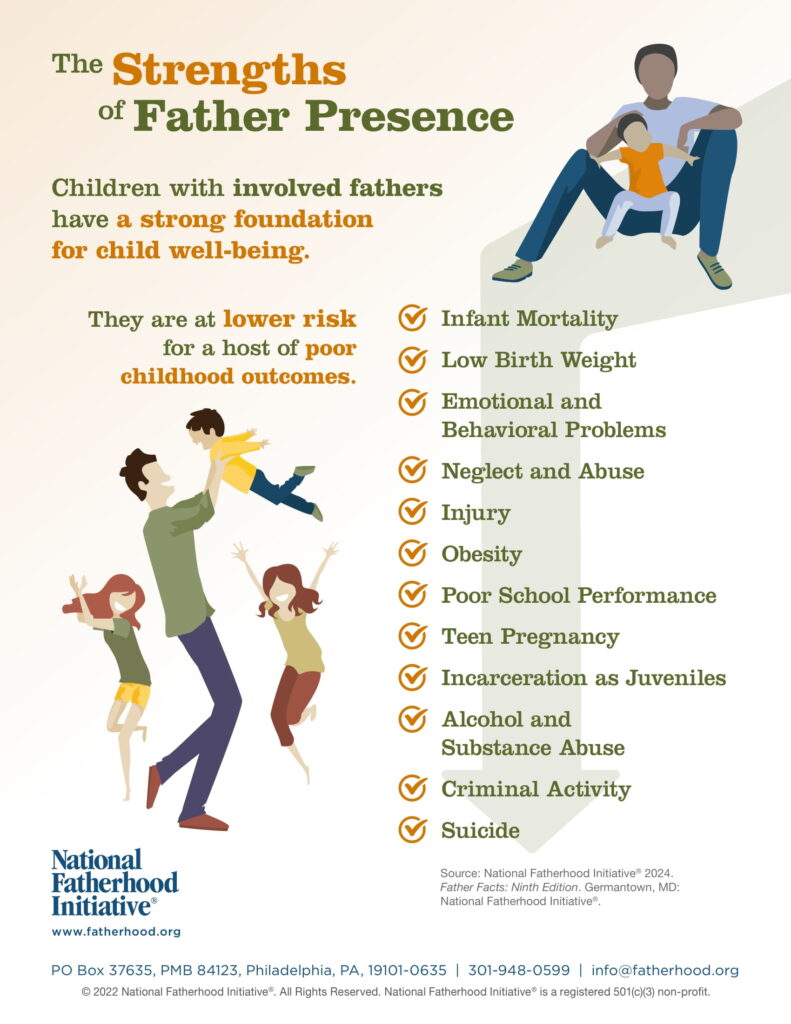
Put simply, the NFI’s research has found that an involved father acts as a protective factor, significantly lowering the risk of a whole range of adverse outcomes in children.
Some of the benefits listed on the infographic are quite obvious. Others took me by surprise. Let’s briefly consider these benefits in four key categories.
1. Physical Health and Safety
It was the statistics relating to a child’s physical health and safety that surprised me most when I first saw this graphic.
According to the NFI, children with involved fathers have a lower risk of dying in their first year, are less likely to be born underweight, experience fewer preventable accidents or injuries, and have a lower chance of childhood obesity.
To hone in on just two of these:
- Children without involved fathers are at least twice as likely to suffer from childhood obesity.
- Newborns are 4 times more likely to die if their father is absent.
So much for toxic masculinity!
2. Emotional and Mental Well-Being
This cluster of benefits is perhaps the most obvious.
Children with involved fathers are at significantly lower risk of emotional and behavioural problems and suicide.
In fact, children of single mothers show higher levels of aggressive behaviour than children born to married mothers. In other words, the presence of the child’s father in the home reduces their aggressiveness. This fact also fails to square with the “toxic masculinity” narrative.
The reason is obvious when you think about it: involved fathers foster resilience and emotional security — something every child needs.
3. Social and Legal Outcomes
Another set of dangers that involved fathers protect against are negative social and legal outcomes.
Children of involved fathers have a lower chance of experiencing neglect and abuse, a decreased risk of alcohol and substance abuse, reduced involvement in criminal activity, and less likelihood of ending up in the juvenile justice system.
Consider just two more facts from NFI that illustrate the disparity:
- Children with a single parent and live-in partner are 10 times more likely to experience abuse and 6 times more likely to experience neglect than those living with married biological parents
- 1 in 5 prison inmates had a father in prison
Far from being toxic, a father’s presence in their child’s life helps steer them away from harmful choices in their relationships and community.
4. Educational and Future Success
The final set of benefits is in the realm of school and life trajectory.
Teenagers without fathers are twice as likely to drop out of high school. They are also 7 times more likely to become pregnant and twice as likely to engage in early sexual activity.
Or, to put the shoe on the other foot, involved fathers statistically supercharge their child’s success in school and guide them to good decisions around sexuality and relationships.
Fatherhood, far from being “toxic”, is an incredible protective factor that majorly reduces a whole variety of risks for children.
The benefits of fatherhood extend far beyond the home, impacting children’s health, safety, and future success.
Keep that in mind next time someone uses the phrase “toxic masculinity”.
___
Image courtesy of Adobe.

Related News

Whether new to the dad guild or a veteran dad-lifer, blunt affirmations offer sharp relief. Telling ourselves objective truths keeps us fit for the fight.
Rod Lampard

The New Year holds promise for us all. A fresh beginning, a new start, a grand opportunity to start over. We reflect on what we have done and where we have been and what we should do. Sometimes this self-reflection can be discouraging but it is an activity that should be pursued nonetheless for the greater good of all. Many years ago, after some time of reflection and prayer in the ...
Warwick Marsh
News
Dads4Kids News is for writers to share insights, stories, the latest research and news to encourage dads and their families.
Most Read
The opinions of our writers are not necessarily the opinion of Dads4Kids. Please do your own research and come to your own conclusions. We welcome feedback and if you would like to submit an article to Dads4Kids, please contact the editor at info@dads4kids.org.au