
Knowing What To Love
December 26, 2024

You can’t love what you don’t know. This saying has profoundly influenced our marriage and our faith.
About once a decade we book tickets to the opera in the expectation of a romantic date night brimming with artistic delight. We have to confess though, we usually come home vaguely disappointed.
Not being particularly musical, we don’t understand the technical expertise. Nor do we know the traditions and history (or often the language) that are part of the performance.
Thus, we can appreciate opera in only a very limited capacity because we don’t really know enough about it. The same principle applies to our relationship: the better we know our spouse, the greater our capacity to love them.
Equally, we can’t share with the other what we don’t know about ourselves. Genuine intimacy – the mutual sharing of our interior lives with the other – requires that we first have an intimate knowledge, and love, of ourselves.
The Johari Window
A useful framework for visualising this is the Johari Window. Picture a four-paned window that represents you. Within the window is everything that is known and unknown about you.
It includes factual information such as your age, sex, the school you attended and so on. It also includes your history, your memories, genetic and medical facts, your emotions, hopes, character and personality traits.
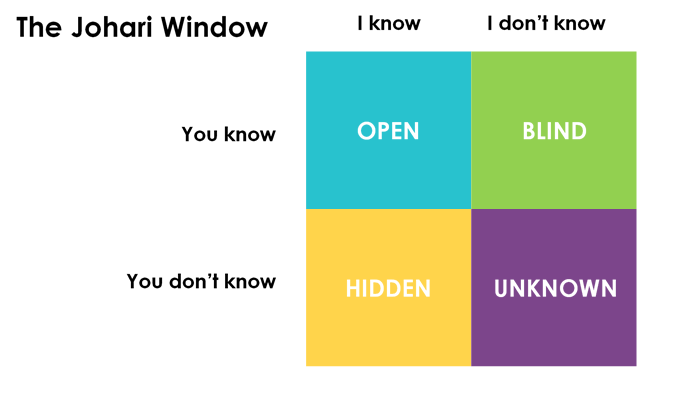
Each of the four panes represent different combinations of what you or your spouse know or don’t know about you:
- The Open pane contains those things that both of you know about you.
- The Hidden pane contains those things that you know about yourself, but your spouse does not. In some relationships it can be good judgement to not disclose personal information, However, deliberately withholding significant information in our marriage can be very damaging to our trust.
- The Blind area has all those things that your spouse knows or sees in you that you don’t know, or to which you don’t like to admit about yourself, such as a virtue or personality flaw.
- Finally, the Unknown area is a mystery to you both and awaits discovery.
Growing Our Love
For our marriage relationship to thrive and deepen in intimacy, we will need to increase the Open pane, and reduce the others.
The first task is for me to be actively pursuing self-awareness. Simple practices like regular self-reflection and prayer are a practical way to do this, and so decrease my Blind areas.
This process of exposing our Blind spots can be painful as some information will highlight our shortcomings. However, this is necessary if we want to grow and change.
It’s not all unpleasant though, as many of us have strengths and qualities that we have difficulty recognising and accepting through impaired self-esteem.
The ‘Examin’ – a daily prayer practice made popular by St Ignatius – is a valuable process for increasing our self-awareness, deepening our love for God, and growing in self-acceptance.
For the more I know and love myself, the more I have to share and the more willing I am to share it through self-disclosure. This will reduce the Hidden area in our relationship.
Shared Discovery
When we had our first child, expectations and instincts about parenting were revealed that were unexpressed until that time. This was an Unknown aspect of our personhood, and there will be many such opportunities as we journey through life together.
When we simultaneously decrease the Blind and Hidden areas, this process of shared discovery enlarges the Open area and reduces the Unknown area.
As we grow in knowledge of our ourselves and of each other, our capacity for love also grows. And with this knowledge, we can choose to love in ways that helps us both to grow and develop towards the person God created us to be.
For knowledge is not only power (to quote another famous saying); it is the foundation for intimate loving.
___
Republished with thanks to SmartLoving. Image courtesy of Unsplash.

Related News

Editors Note: It is not often I include a guest post on the Justaman blog but Tony Palombi is a great man with a great story and a great family. He shares the pain of growing up in a broken home and the hope within him. Divorce hurts our children. Lets not go there! Children Feel the Pain of Marital Conflict & Divorce My name is Tony Palombi and yes, it’s ...
Warwick Marsh

VISIT FROM THE MARRIAGE AUDITOR Imagine you received a phone call that went something like this: “Mr & Mrs Herald, we need to make an appointment with you to do a ‘Marriage Audit’. Can we make it 8.00pm tonight? Thank you. See you at 8.00pm.” Marriage Audit? I’ve heard of a tax audit, but what on earth is a ‘Marriage Audit’? 8.00pm comes and the ‘Marriage Audit’ team arrive. For 30-45 ...
Warwick Marsh
News
Dads4Kids News is for writers to share insights, stories, the latest research and news to encourage dads and their families.
Most Read
The opinions of our writers are not necessarily the opinion of Dads4Kids. Please do your own research and come to your own conclusions. We welcome feedback and if you would like to submit an article to Dads4Kids, please contact the editor at info@dads4kids.org.au