
What This Crying Toddler Knows That Our Culture Would Rather Forget
August 13, 2026
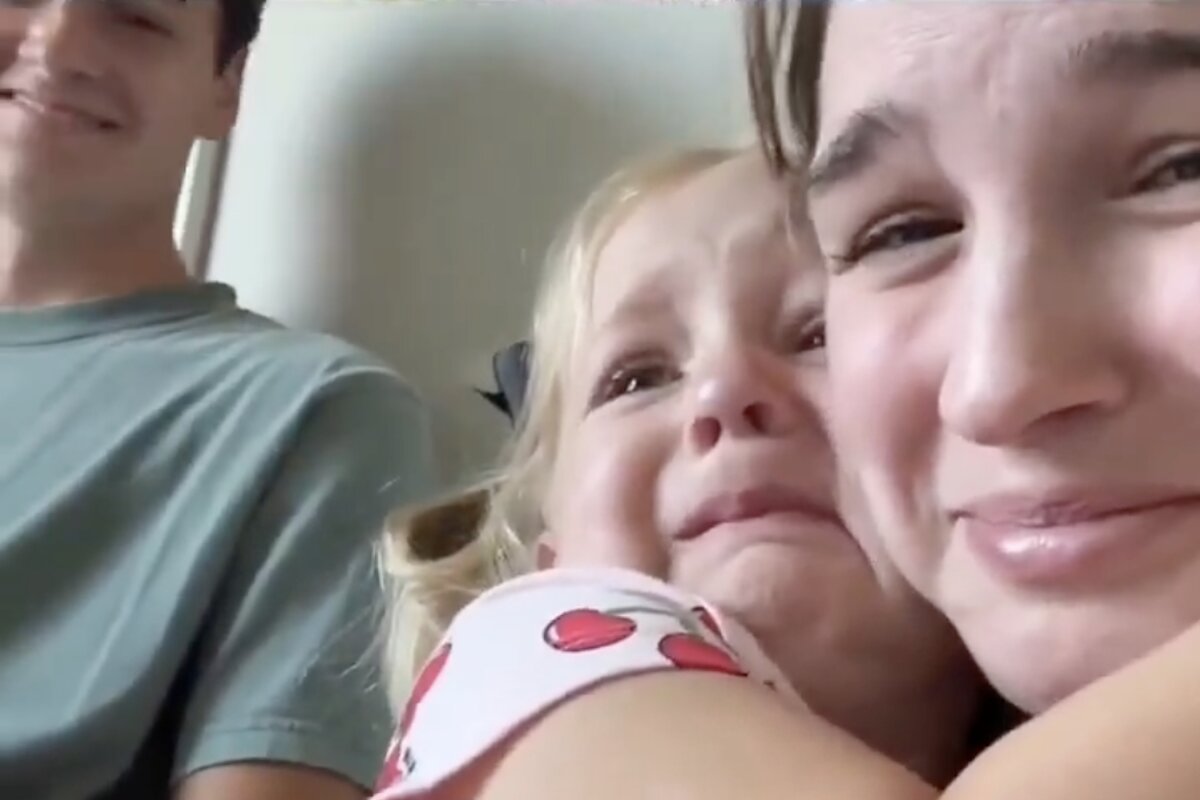
Did you see the post that went viral last week showing a three-year-old girl crying over her parents’ wedding video?
If you did, you’d know exactly the one I’m referring to. If you didn’t, you should join the 2.4 million-plus people who viewed it and watch it below:
Parents show their 3-year-old daughter their wedding video for the very first time… and her reaction is absolutely priceless. 🥹❤️ pic.twitter.com/MLTUaP00Qn
— Liza (@Li33aaa) August 2, 2026
I’m not crying, you are!
It’s a sweet and sentimental moment that fathers of three-year-old girls like myself can easily relate to. But it also underscores a serious fact about how children tick — and what they need in family.
Love, Felt Indirectly
Reflecting on this video, children’s advocate Katy Faust wrote a column titled ‘They Loved Me Without Looking’ in which she quotes the following words from Pat Fagan, a marriage researcher and family therapist:
When a child sees their mother loving their father, they feel like their mother is loving them. When they see their father loving their mother, they feel like their father is loving them. It is the only time in the human experience where you can be loved indirectly. No one’s even looking at you or touching you or talking to you, but you feel loved.
Faust goes on to explain:
Everywhere else in life, a child has to be looked at, spoken to, reached for. Here, and only here, love arrives without ever being aimed. It reaches them sideways, through the bond between the two people who made them. That little girl has no words for what is happening to her. She only has the tears, and the tears are true.
If every child could order their own world, Faust argues, what they’d ask for is this: “I want my mum and dad to love me, and I want my mum and dad to love each other.” Those are the foundation stones of a child’s security, she says — and the real reason the girl in the video was overcome with emotion.
A Truth Our Culture Would Rather Ignore
According to Faust, this is also why the nuclear family is sacred — and why easy divorce, de facto living, surrogacy and other “alternative” family arrangements our culture is so desperate to normalise actually deserve serious critique. “Woe to a culture that intentionally denies that to children in the name of adult freedom,” she declares.
Faust acknowledges that an intact marriage is sometimes out of reach or denied by tragic circumstances. But her core claim stands: a marriage never belongs to the couple alone, but also to the children that marriage has produced. Or more simply, children have a natural right to a married mother and father, and it’s on all of us to protect that right on their behalf.
Incidentally, a report published last month adds academic weight to Faust’s concerns.
Put out by the American Enterprise Institute and the Institute for Family Studies, the report analysed US government data on how children from “intact, married-parent” homes fare against children from every other family arrangement — whether step-families, cohabiting households or single-parent homes.
The gaps were glaring. Children without intact families were 13% less likely to get good grades (As and Bs), 47% more likely to have their school contact their parents over their behaviour, and more than twice as likely to be diagnosed with depression.
Even when researchers controlled for other factors like race, income and parents’ education, the gap remained. Family structure was one of the strongest predictors of a child’s outcomes across the board — and it was children from intact, married-parent homes who consistently came out ahead.
One study they cited out of Virginia found no racial gap at all in the academic performance between black and white children raised in intact families. In other words, what’s often dressed up as a racial gap is actually a family-structure gap in disguise.
The researchers’ findings weren’t exactly groundbreaking. They traced similar findings back to a landmark 1966 US government study that found family background shaping a child’s education more than race, poverty or almost any other measure researchers considered.
All of this would surely go over the head of the teary-eyed girl in the viral video. But in the depths of her tender little heart, she knows a truth that researchers spend their careers proving, and that our culture would rather not hear: so long as mum and dad love each other, everything is going to be okay.

Related News

Some time ago, a young father sent me this incredible story about David Campbell. David is the son of the iconic Aussie singer Jimmy Barnes. David Campbell happens to be a singer himself, and a co-host on the ‘Today Extra’ show on Channel Nine. Read the full story here. Watch the performance below, of a father and son capturing the raw emotion of this story. If you don’t know anything about ...
Warwick Marsh
by Assal Habibi Observing a pianist at a recital – converting musical notations into precisely timed finger movements on a piano – can be a powerful emotional experience. As a researcher of neuroscience and a pianist myself, I understand that the mastering of this skill not only takes practice, but also requires complex coordination of many different brain regions. Brain regions – that are responsible for our hearing, sight and movement ...
Guest Writer
News
Dads4Kids News is for writers to share insights, stories, the latest research and news to encourage dads and their families.
Most Read
The opinions of our writers are not necessarily the opinion of Dads4Kids. Please do your own research and come to your own conclusions. We welcome feedback and if you would like to submit an article to Dads4Kids, please contact the editor at info@dads4kids.org.au